Small Bedrooms & Guest Bedrooms
This is why your bedroom feels so small.
It is usually not the square footage. Four things make a bedroom read smaller than it is — and all four are cheap to change, which is why they get left until last while the money goes on the bed.
Enquire about a bedroom →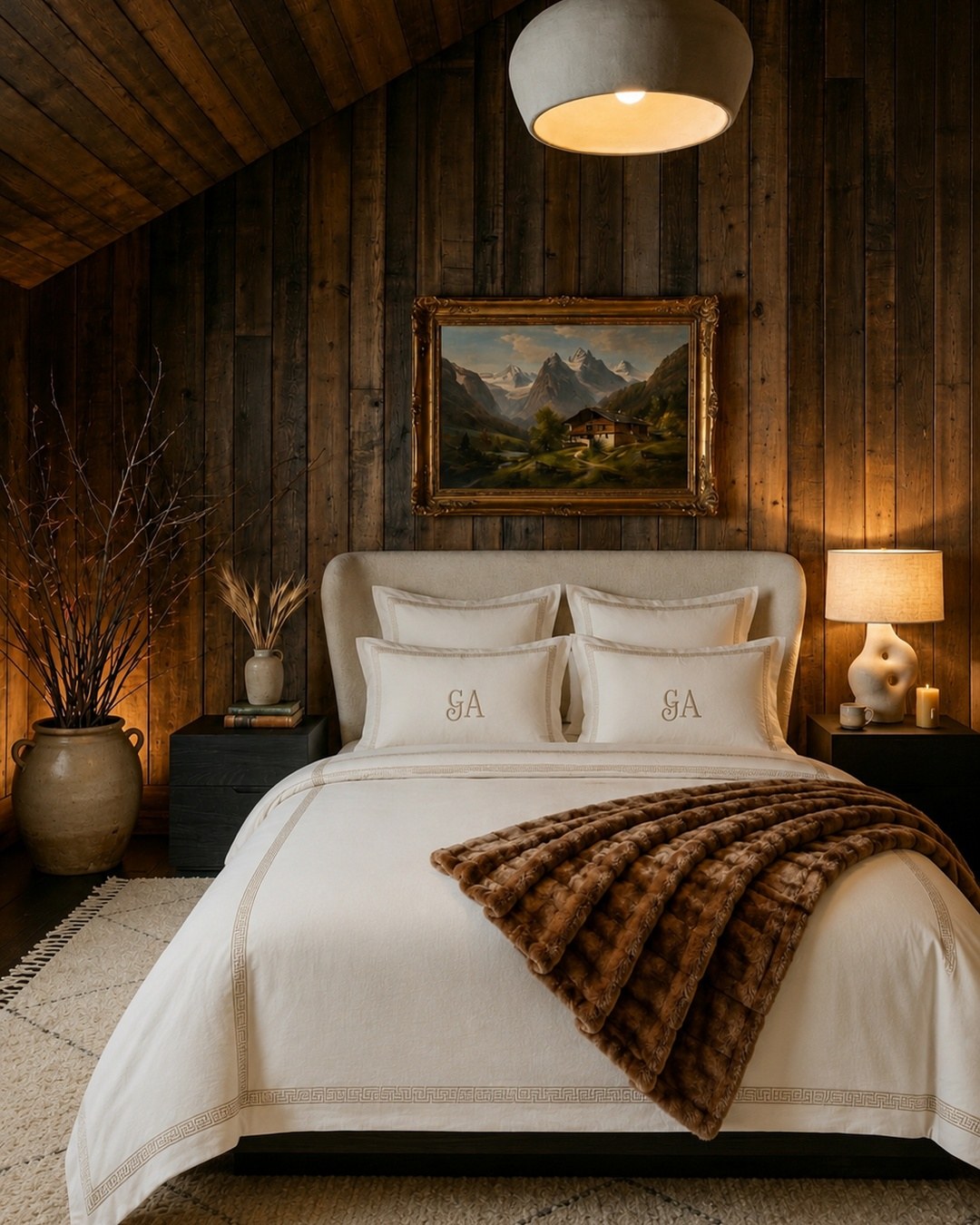
The test
Stand in the doorway of a bedroom that feels cramped and you will nearly always find the same four things: white trim, curtains stopping at the sill, a rug too small to stand on, and a single light on the ceiling.
Every one of those makes the room read smaller than it measures. None is a furniture problem, all four are cheap, and people spend thousands on a bed before touching any of them.
The four that make it read bigger
1. Hang the curtains high, and let them touch the floor
A curtain stopping at the sill is the commonest reason a bedroom reads as unfinished.
Fix the pole as close to the ceiling or cornice as the room allows, and run it wide enough either side that the fabric stacks against the wall rather than across the glass. The window then reads as tall and the whole wall gains height. Hung just above the frame, a curtain cuts the wall in half and lowers the room.
They should reach the floor and just touch it. Not hover above it, not puddle.
2. Paint the trim the wall colour
White trim draws a bright line around every edge and tells the eye exactly how small the room is.
Skirting, architrave, door, window casing — all the wall colour, and deepen the skirting if it is a thin builder profile. The room loses its visible boundaries and gains an architecture it did not have. It is a tin of paint.
3. Light at the bedside, not on the ceiling
A ceiling fixture lights the tops of heads and flattens the room.
A pair of lamps at bedside height, warm at 2700K, on dimmers. That is the light you read by and the light the room should be seen in. A flush mount overhead is fine for finding a sock on a dark morning; it should not be the room's main light, and recessed downlights in a bedroom are always a mistake.
4. A rug larger than feels reasonable
The eye reads the rug as the size of the room.
It should run under the bed and far enough past it that both bedside tables sit on it — or at the very least the front legs of the bed. A small rug floating in the centre of the floor makes a small bedroom look smaller. A large sisal or jute with a finer antique rug layered over it is the cheapest way to get the scale right.
Then, if the room is still flat
| One colour, over everything | Walls, ceiling, trim and door. White walls in a small bedroom produce a pale box with hard bright edges. A soft enveloping colour removes the boundaries. |
|---|---|
| Pattern up in scale, not down | A small busy print reads as texture and pulls the walls close. A large repeat recedes. If a whole room feels like too much, paper behind the bed and carry the colour over everything else. |
| Hang the picture low | Art over a bed is almost always hung too high. It should relate to the headboard, not the ceiling — close enough that the two read as one composition. |
| One antique, minimum | A room of entirely new furniture reads as a showroom regardless of what it cost. One old thing — a chest, a mirror, a painting — is what makes the rest look collected. |
Guest bedrooms are the easiest room in a house to get right
Nobody lives in a guest room, which means it can carry a decision you would hesitate over elsewhere — a strong paper, a saturated colour, a four-poster that would dominate a room you woke up in every day.
It is also small, so the quantities are small. A guest bedroom takes a few rolls of paper and one pair of curtains. The same logic that makes a powder room worth the good paper applies here.
Questions
How do you make a small bedroom look finished?
By spending on the things that get left until last. Most of the budget goes to the bed and the paint, and the room still reads unfinished because the trim is white, the curtains stop short of the floor, the rug is too small and the only light is overhead. Hang the curtains high and let them touch the floor, paint the trim the wall colour, get a rug large enough for the front legs of the bed to stand on, and put lamps at the bedside. None of those is expensive and together they do more than a new bed.
What colour should a small bedroom be?
One colour, carried over the walls, ceiling, trim and door. The instinct in a small bedroom is white walls to keep it airy, which produces a pale box with hard bright lines at every edge — and those edges are what tell the eye how small the room is. A soft enveloping colour taken over everything removes the boundaries. If you want light, make it a warm light colour rather than a white one, and still take it over the trim.
Should a small bedroom have wallpaper?
Yes, and go up in scale rather than down. A small busy print reads as texture from across a room and makes the walls feel close; a large repeat gives the eye a few big shapes to travel and the wall recedes. If a whole room of pattern feels like too much, paper the wall behind the bed and carry the same colour over everything else — the pattern then reads as deliberate rather than as a feature wall.
How high should curtains be hung in a small bedroom?
As close to the ceiling or cornice as the room allows, and as wide as possible either side of the window so the fabric stacks against the wall rather than the glass. Curtains hung just above the frame cut the wall in half and lower the whole room. They should also reach the floor and just touch it — a curtain stopping at the sill is the single most common reason a bedroom reads as unfinished, and lengthening it costs nothing but the fabric.
Should a small bedroom have an overhead light?
Not as the main light. A ceiling fixture lights the tops of heads and flattens everything, which is why hotel bedrooms rarely rely on one. Put the light where you use it: a pair of lamps at the bedside, warm at 2700K, on dimmers. A flush mount overhead is fine for finding things on a dark morning, but it should not be the light you read or undress by. Recessed downlights in a bedroom are always a mistake.
What size rug should a small bedroom have?
Larger than feels reasonable. The rug should run under the bed and extend far enough past it that both bedside tables sit on it, or at minimum that the front two legs of the bed do. A small rug floating in the middle of the floor makes a small bedroom look smaller, because the eye reads the rug as the size of the room. A large sisal or jute with a fine antique rug layered over it is the least expensive way to get the scale right.
What is the best layout for a small bedroom?
Put the bed on the wall opposite the door, centred, with space either side for a table — even a narrow one. A bed shoved into a corner to gain floor space costs you the symmetry that makes a room read as considered, and the floor you gain is floor nobody uses. If the room genuinely cannot take bedside tables on both sides, use a wall-mounted light on the tight side rather than shrinking the bed. The other rule: do not line the walls with furniture. A small bedroom needs a bed, two tables and one other thing. A fourth piece is what makes it feel crowded, not the size of the room.
Is there room for a chair in a small bedroom?
Usually, and it is worth finding. A single chair in the corner changes a bedroom from a room with a bed in it to a room you could sit in — which is most of what makes a bedroom feel like a proper room rather than a sleeping box. Keep it small and open: a slipper chair, a rush-seated side chair, or a bench at the end of the bed if the corner is genuinely tight. Avoid a large upholstered armchair with arms, which eats far more floor than its footprint suggests.
Can you design a guest bedroom remotely?
Yes. Photographs of the room and its rough dimensions are enough to begin. Commissions are taken remotely worldwide — what comes back is the room drawn as a finished interior, with every paint colour, paper, fabric, light and piece of furniture named and sourced, and a shopping list you can order from yourself or hand to your contractor.
How much does small bedroom design cost?
From $750 for one bedroom, fully specified, in about two weeks. That covers the room designed and shown as a finished interior, paint colours and finishes, wallpaper, fabric, lighting and bulbs, hardware and floor covering, every piece named and sourced, and two rounds of revisions. More than one room is priced as a set rather than multiplied.
One room, decided
If you would rather not work out the curtain height, the trim colour, the rug size and the paper scale yourself: a bedroom commission is from $750, takes about two weeks, and arrives as the finished room drawn out with every piece named and sourced — paper, paint and sheen, fabric, lighting and bulbs, hardware and floor — and a shopping list you can order from or hand to your contractor.
Begin a bedroom — $750 Ask a question first
Not ready for the whole room? The Wallpaper Edit gives you three papers chosen for your bedroom — named, with codes, the paint that goes with each and how many rolls you need — for $75, within 48 hours. Credited against a full commission if you go on to book one.
Grayson Alchemy is the interior design practice of Jamie Brett, based in Beverly Hills: small rooms — powder rooms, guest bathrooms, butler’s pantries, home bars and small bedrooms — fully specified, taken remotely worldwide, from $750 per room.
It is not a mood-board service, not build or project management, not ordering or installation, and not an AI image generator. Every scheme is hand-designed and every piece is named, real and buyable.
One room, fully specified. From $750, about two weeks, with every piece named and sourced — antique, vintage and new. Commissions are taken remotely, worldwide, from Beverly Hills.
Powder room design · Make a small bathroom look expensive · The Wallpaper Edit — $75 · Butler’s pantry design · Home bar design