Small Bathrooms
The same room, finished differently, reads as expensive.
A small bathroom looks builder-grade because of what it is finished in, not because of its size. Every decision below costs the same as the ordinary version — and not one of them requires another square foot. If it is the sense of space you are after rather than the finish, that is a different question, answered here.
Enquire about a small bathroom →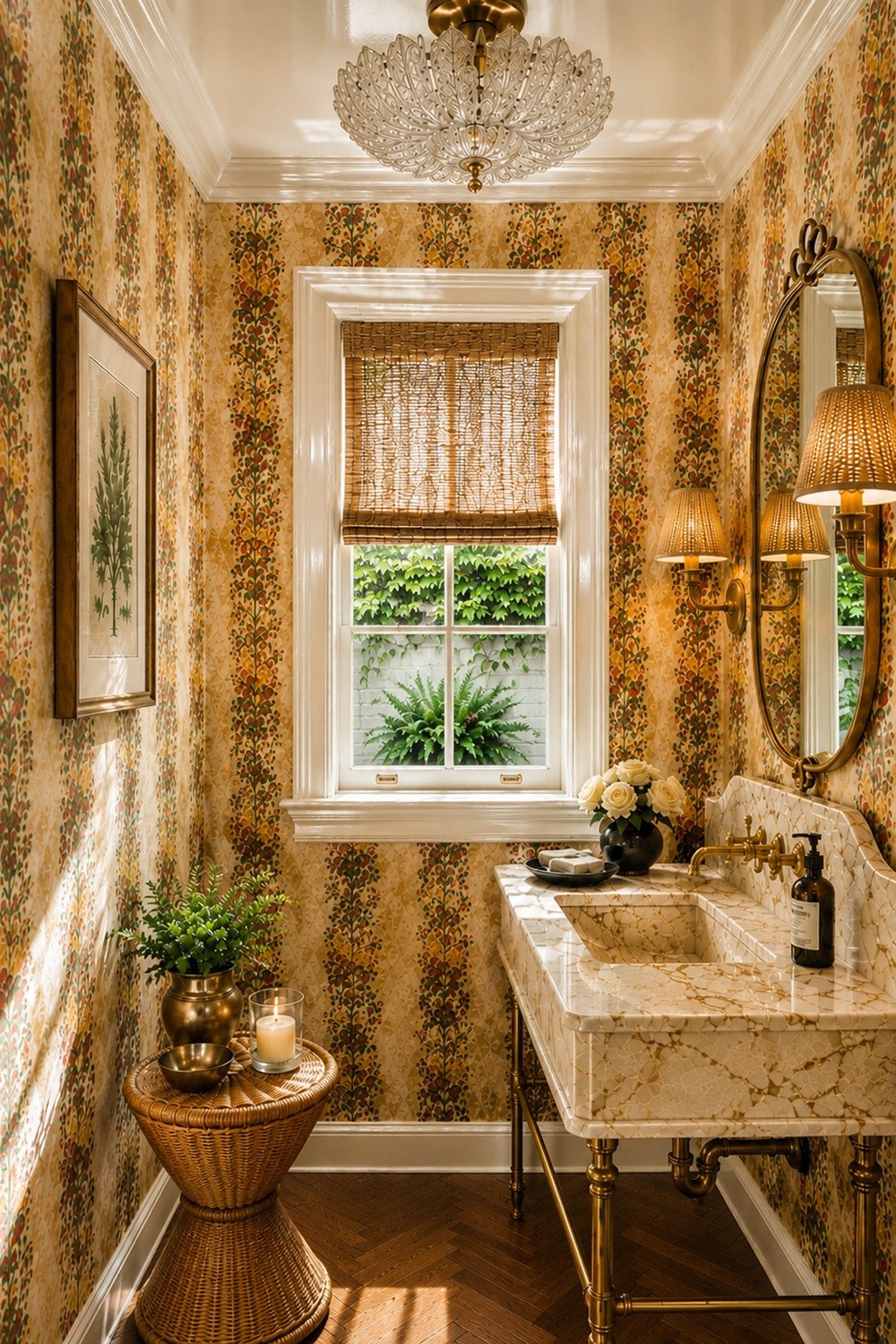
First, the advice everyone gives you
Search this question and you will be told the same five things: paint it white to make it feel bigger, hang the biggest mirror you can find, add an LED mirror for a spa feel, use marble-look vinyl or large-format tile to reduce grout lines, and swap the fixtures for gold.
Follow that list exactly and you will produce the bathroom you are trying to get away from. Those five moves are not neutral — they are the specific reasons small bathrooms read builder-grade. White flattens. A wall-filling mirror doubles the pattern and halves the room. An LED mirror is a lit rectangle of cold light on a wall. Marble-look anything announces what it is not. And bright polished gold from a big-box shelf is the single fastest tell in a bathroom.
Every one of those moves is chasing the same goal: making the room seem larger than it is. That is a separate question, and a mostly unwinnable one. This page is about the other one.
The real answer is duller and it works. Luxury in a room this size is almost entirely a question of surfaces and sheen.
The six decisions that actually change it
1. One colour, over everything, in the right sheen
Walls, ceiling, door, architrave, skirting — the same colour. Pale walls under a white ceiling put a hard bright line around the top of the room and tell the eye exactly where the box ends. Take the colour up and over and the edges disappear.
The sheen carries as much as the colour. Flat paint in a small room looks chalky and marks by the light switch within a month. Estate Eggshell on joinery and Modern Emulsion on walls is the working default; on a windowless room, Full Gloss on the joinery is what gives depth that no amount of white ever will.
Colours that hold up at this scale: Farrow & Ball Studio Green, Bancha, Hague Blue, Green Blue, Dead Salmon. A small room is the one place a saturated colour is a low-risk decision — you are in it for ninety seconds and it takes a litre.
2. Deep skirting, and no white trim anywhere
This is the least expensive change on the page and the one that does the most. A three-inch builder skirting in gloss white is the developer signature. Replace it with seven to eight inches in a simple profile, painted the wall colour, and the room acquires proportion it never had.
Same for the door, the architrave and the window casing. White trim is not a neutral default — it is a decision, and it is the wrong one here.
3. The basin on legs, not a vanity on the floor
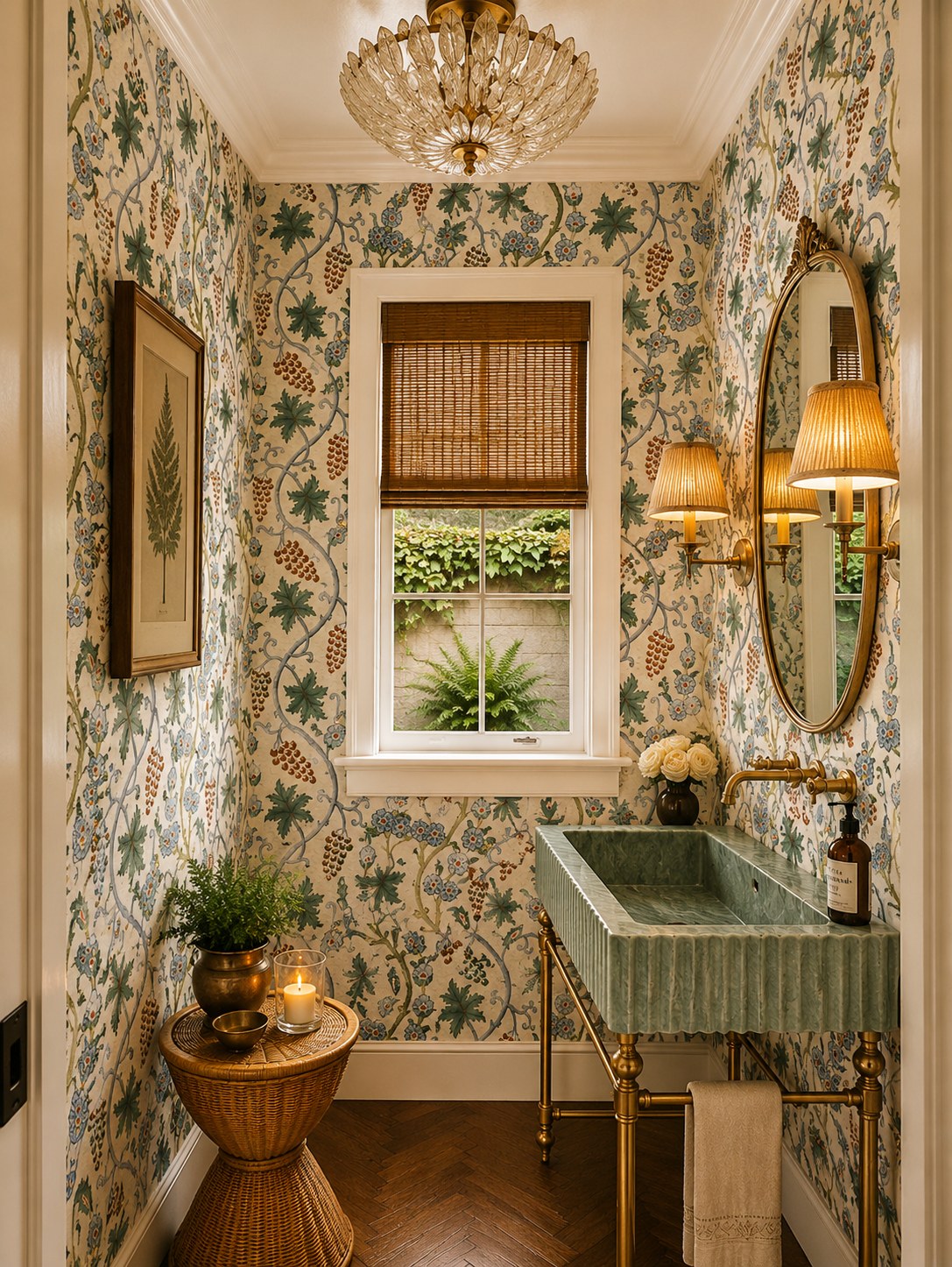
A cabinet sitting on the floor fills the room visually to its full footprint. A console basin on slender brass legs, or a wall-hung basin, leaves the floor visible underneath — and a room where you can see the floor across its whole width reads considerably larger.
It also turns a fitting into furniture, which is the whole difference between a bathroom that was installed and one that was decorated.
Undermount the bowl, always. A vessel sink sitting on top of a slab is the one detail that makes an otherwise good room look like a showroom display.
4. Honed stone, warm and veined — never polished
Polished stone in a small room bounces hard light and looks like a countertop. Honed stone absorbs it and looks like a material. It is the same slab and usually the same price.
Choose warm veining over cold grey. A Calacatta with gold and grey movement, a Breccia, a Rosso, a Viola — anything with warmth in it will sit with brass and with wallpaper. Cool grey marble fights both. ABC Worldwide Stone is where to look at real slabs rather than samples.
And use a thick square edge. A thin bullnose is the fastest way to make expensive stone look thin.
5. One metal, unlacquered, and let it age
Pick a single metal and carry it through every element — tap, waste, trap, basin legs, sconces, mirror frame, door handle, towel ring, hinges. Mixing metals in a room this small reads as indecision, not layering.
Unlacquered brass is the one that improves. It arrives bright, darkens unevenly around the handles within a year, and ends up looking like it has been there for decades. Lacquered brass stays exactly as bright as the day it arrived, which is the problem. Waterworks for taps; wall-mounted where the plumbing allows, because it clears the stone and lets the slab read as one surface.
6. Light from the sides, warm, on a dimmer
A pair of sconces flanking the mirror at face height — never a single fixture above it, and no recessed downlights. Downlights light the tops of heads, kill a papered ceiling, and undo everything above in one move.
Specify 2700K and nothing cooler, with high colour rendering. At 3000K and above a dusty rose goes grey and a plum goes blue, and you will have chosen a beautiful room and installed a cold one. The full lighting specification is here, and it matters most when there is no window.
Where the money goes — and where it doesn’t
The useful thing about a room this size is that quantities are small. Three rolls of paper. A litre of paint. One slab remnant. One tap. An expensive specification in a powder room costs less in absolute terms than a mediocre one in a bathroom three times the size.
So concentrate everything on what is at eye level and what you touch.
| Spend here | Wallpaper or wall finish — it is most of what you see. Thibaut for document-based papers at a sane price; Gracie or de Gournay if the room is taking hand-painted. Phillip Jeffries grasscloth where a pattern would be too much. |
|---|---|
| The mirror and the sconces — both at eye level, both read as furniture. An antique mirror beats a new one at the same money. | |
| The tap — the only thing in the room a guest physically touches. | |
| Spend nothing extra | Floor tile, extractor fan, toilet, towel ring, toilet-roll holder, cabinet hardware nobody opens. No one has ever noticed a good toilet. |
The test
Stand in the doorway and ask which surface your eye lands on first. If it is a bright white edge — the ceiling line, the skirting, the architrave — that is the thing making the room feel small and ordinary, and it is a tin of paint away from being fixed.
A small bathroom that feels luxurious is not a small bathroom pretending to be a big one. It is a small room that has stopped apologising for its size and been finished properly instead.
Questions
How do you make a small bathroom feel luxurious?
By changing the surfaces, not the layout. A small bathroom reads builder-grade because of what it is finished in — flat white paint, a thin skirting board, a polished slab, a vanity sitting on the floor, chrome. Change the sheen, deepen the skirting, hone the stone, lift the basin onto legs and switch the metal to unlacquered brass, and the same room reads expensive at the same square footage. Nothing on that list requires more space.
How do you make a small bathroom look expensive?
Concentrate everything on what is at eye level and what you touch — the wall finish, the mirror and sconces, and the tap — and specify the rest plainly. Because a powder room takes about three rolls of paper and a single slab remnant, an expensive specification here costs less in absolute terms than a mediocre one in a bathroom three times the size. What reads as expensive is honed stone rather than polished, a basin on legs rather than a cabinet on the floor, deep skirting in the wall colour rather than thin white trim, and one unlacquered metal carried through every fitting.
Should a small bathroom look like a spa?
It is a popular ask and it is worth resisting. A spa is a commercial interior designed to feel impersonal — pale stone, cool light, no pattern, nothing anyone owns. Reproduced at home it reads as a hotel bathroom, which is the opposite of the room feeling like yours. A powder room is the one place in a house where you can be properly decorative without living with the decision all day. Use it for that instead.
What colour should a small bathroom be?
Saturated, and carried over every surface including the ceiling. A small room is the one place where a strong colour is a safe decision, because you are only living with it for ninety seconds at a time and the quantity is tiny. What fails is a pale colour on the walls with a white ceiling and white trim — the contrast draws the eye to every edge and tells you exactly how small the room is. One colour everywhere removes the edges and the room reads larger, not smaller.
Is wallpaper a good idea in a small bathroom?
It is the best room in the house for it, for a reason that is purely financial: a powder room or guest bathroom takes about three rolls. A paper you could never afford across a bedroom becomes a modest decision here. Carry it over the ceiling as well — stopping at the cornice puts a hard line around the room and makes it read smaller. Specify a paste-the-wall paper, run a good extractor fan, and it will outlast the paint.
What is the one thing that makes a small bathroom look builder-grade?
Thin white trim. A three-inch builder skirting in gloss white, an architrave in the same, and a white ceiling above a coloured wall — that combination is what reads as developer-grade, and it costs nothing to change. Deepen the skirting to seven or eight inches, paint it and the door and the architrave the same colour as the walls, and the room gains a sense of architecture it did not have.
Where should you spend the money in a small bathroom?
On the two things at eye level and the one thing you touch: the wallpaper or wall finish, the mirror and sconces, and the tap. Those are what register. Spend nothing extra on the floor tile, the extractor, the toilet or the towel ring — nobody has ever noticed a good toilet. Because the room is small, an expensive paper and a good tap cost less here in absolute terms than mediocre versions would in a bathroom three times the size.
One room, decided
If you would rather not work out the sheen, the skirting height, the stone finish and the paper quantity yourself: a small bathroom commission is from $750, takes about two weeks, and arrives as the finished room drawn out, with every piece named and sourced — paper, paint and sheen, basin, tap, lighting, bulbs and hardware — and a shopping list you can order from or hand to your contractor.
One room, fully specified. From $750, about two weeks, with every piece named and sourced — antique, vintage and new. Commissions are taken remotely, worldwide, from Beverly Hills.
Tiny powder rooms · Windowless powder rooms · Powder room design · Butler’s pantry design · Home bar design