Small Bathrooms
A big mirror will not make your bathroom bigger.
Most of the standard advice for small bathrooms makes them look smaller. Here is what each of those moves actually does — and the four decisions that genuinely change how large a small room reads.
Enquire about a small bathroom →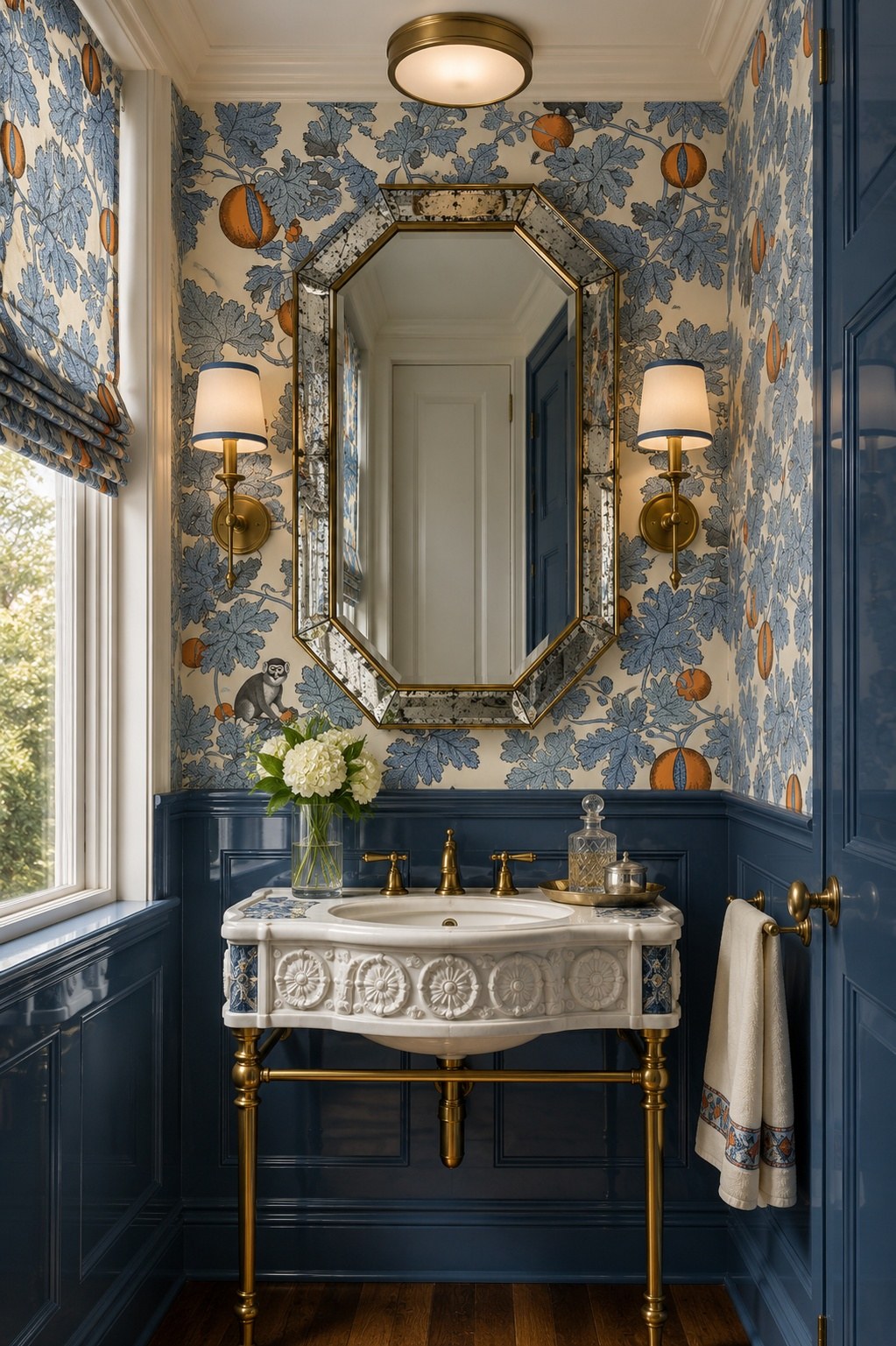
The five things that don’t work
Painting it white
It flattens the room and draws a bright line around every edge.
White has no depth, so the walls sit at a fixed distance and stay there. In a room with little daylight it goes slightly grey. And white walls almost always arrive with a white ceiling and white trim, which puts high-contrast lines at the top and bottom of every wall — telling the eye precisely where the box ends.
The biggest mirror you can fit
Size is not the variable. Position is.
A wall-filling mirror in a small bathroom mostly reflects the opposite wall. You get the pattern twice, the fittings twice, and a room that reads busy rather than open. Depth comes from being able to see through the room, not from more reflective surface.
Large-format tile
Fewer grout lines, but cut tiles at every edge.
The reduction in visual noise is real and small. What you also get is a cut tile against every wall, which draws attention to how little floor there is — and a finish that reads as hotel and lobby rather than as a room in a house.
A small, delicate pattern
Backwards. Small pattern reads as texture, and texture pulls a wall closer.
From three feet away a small busy print stops being a pattern and becomes a surface. Large-scale pattern in small rooms is one of the few rules worth following without exception: the eye gets a handful of big shapes to travel across, the repeat never appears within the room, and the wall recedes.
Stripping everything out
An empty small room is still a small room, with nothing to look at.
The instinct is that less furniture and less ornament means more space. What it actually produces is a small white room containing fittings. The room is no larger — there is simply nothing to notice except its size.
The four that do
| Leave the floor visible | The most effective change available. A cabinet on the floor fills the room to its full footprint; a console basin on slender legs or a wall-hung basin lets the floor run uninterrupted underneath. The eye judges room size largely by how much unbroken floor it can see. |
|---|---|
| One colour, over everything | Walls, ceiling, door, architrave, skirting. Remove the bright edges and the room loses its visible boundaries. A white ceiling over a coloured wall is a line drawn at exactly the height you want the eye to stop. |
| Give the eye somewhere to go | Place the mirror to reflect a doorway, a window or a view out — not the opposite wall. One sightline leaving the room does more than any amount of reflective area. |
| Go up in pattern scale, not down | Large repeats recede. Small repeats read as texture and close in. A powder room is the one place a paper too big for a bedroom works, because you only ever see a fragment of it. |
The honest answer
A small bathroom is not going to read as a large bathroom. The four decisions above will genuinely change how contained it feels, and they are worth making — but none of them adds a foot.
What changes how people talk about the room is not its size. It is whether it was finished properly. Nobody walks out of a beautiful powder room and remarks on the square footage. They remark on the paper.
If that is the direction you want, the companion piece is here: how to make a small bathroom look expensive.
Questions
How do you make a small bathroom look bigger?
Four things genuinely change how large a small bathroom reads, and none of them are the usual advice. Leave the floor visible by putting the basin on slender legs or hanging it off the wall. Carry one colour over the walls, ceiling and trim so there are no bright edges marking where the room ends. Position the mirror to reflect a doorway or window rather than the opposite wall, so the eye is given somewhere to travel. And use a large-scale pattern rather than a small one. Everything else on the standard list — white paint, a wall-filling mirror, large-format tile — flattens the room without adding a perceptible inch.
How do you make a small bathroom feel bigger?
You mostly can't, and trying is what makes the room look ordinary. A small bathroom is never going to read as large, and the effort spent faking it produces the flat, white, fitting-filled room most people are trying to escape. What you can change is how much floor is visible, whether there are hard bright edges around the ceiling and skirting, and whether the eye has anywhere to travel. Those three genuinely alter the sense of space. Beyond that, stop measuring the room against a larger one and finish it properly instead.
Does painting a small bathroom white make it look bigger?
No. This is the most repeated piece of advice in interiors and it does not work. White has no depth, so the walls read as flat planes at a fixed distance, and in a room with little daylight it turns slightly grey. Worse, white walls are usually paired with a white ceiling and white trim, which creates high-contrast lines at every edge and tells the eye exactly where the box ends. A single saturated colour carried over every surface removes those edges and the boundaries of the room become harder to read.
Does a large mirror make a small bathroom look bigger?
Not by size alone — position matters far more. A wall-filling mirror in a small bathroom mostly reflects the opposite wall, which doubles the pattern and the fittings and reads as busy rather than spacious. What creates depth is a mirror angled or placed to reflect a doorway, a window, or a view out of the room, because the eye is given somewhere to travel rather than a copy of where it already is. A well-placed modest mirror beats a badly placed enormous one.
Do large tiles make a small bathroom look bigger?
Marginally, and at a cost. Fewer grout lines do reduce visual noise, but large-format tile in a small room means cut tiles at every edge, which draws attention to how little floor there is. It also reads commercial — it is the flooring of hotel bathrooms and lobbies. A small warm floor in wood, a herringbone, or a patterned stone gives the room character, and character is what makes people describe a room as lovely rather than small.
Should you use a small pattern in a small bathroom?
No — this is backwards, and it is the most common mistake in small rooms. A small busy pattern reads as texture from a few feet away, and texture makes a wall feel close. A large-scale pattern gives the eye a few big shapes to follow, the repeat is not visible within the room, and the wall recedes. A powder room is the one place a paper that would overwhelm a bedroom works perfectly, because you only see a fragment of it at a time.
Does a wall-hung or console basin make a bathroom look bigger?
Yes, and it is the single most effective change available. A vanity cabinet sitting on the floor fills the room visually to its full footprint. A console basin on slender legs, or a basin hung off the wall, leaves the floor visible underneath — and the eye judges the size of a room largely by how much uninterrupted floor it can see. The same room with the same fittings reads noticeably larger with the floor showing.
Should a small bathroom ceiling be painted white?
No. A white ceiling above a coloured wall draws a hard bright line around the top of the room at exactly the height you want the eye to stop noticing. Carry the wall colour or the wallpaper over the ceiling instead. The room loses its visible upper boundary and reads as taller and less contained, which is the opposite of what most people expect.
Does dark paint make a small bathroom look smaller?
No, though it is widely believed. Dark colour makes the edges and corners of a room harder to locate, which makes the walls less defined and the room less obviously bounded. Pale colour does the reverse: it shows every junction, every edge and every fitting clearly. A dark small bathroom reads as deep and enveloping. A pale one reads as small and well-lit, which is not the same as large.
What is the one thing most people get wrong when trying to make a small bathroom look bigger?
Stripping the room out. The instinct is that less in a small room means more space, so everything is removed — pattern, colour, ornament, anything on the walls — leaving a small white room with fittings in it. But an empty small room still reads as small; it simply has nothing to look at while you notice. A small bathroom with a strong paper, a proper mirror and warm lamplight gives the eye somewhere to go, and people remember the room rather than its dimensions.
One room, decided
If you would rather not work out the pattern scale, the basin mounting and where the mirror should sit yourself: a small bathroom commission is from $750, takes about two weeks, and arrives as the finished room drawn out, with every piece named and sourced — paper, paint and sheen, basin, tap, lighting, bulbs and hardware — and a shopping list you can order from or hand to your contractor.
One room, fully specified. From $750, about two weeks, with every piece named and sourced — antique, vintage and new. Commissions are taken remotely, worldwide, from Beverly Hills.
Powder room design · Make a small bathroom look expensive · Tiny powder rooms · Windowless powder rooms · Butler’s pantry design